
When is fall protection required? In construction, OSHA requires it at 6 feet or more above a lower level. In general industry the trigger drops to 4 feet. On scaffolds it rises to 10 feet, and in steel erection it sits at 15 feet. Four numbers, four separate standards, and one jobsite where all four can apply on the same afternoon.
That is the reason fall protection stays at the top of OSHA’s citation list. For the fiscal year running October 1, 2024 through September 30, 2025, OSHA’s top 10 most frequently cited standards put Fall Protection general requirements (29 CFR 1926.501) at number one, with Fall Protection Training (29 CFR 1926.503) at number seven. Two of the ten most cited standards in the country come from the same subpart.
The question a foreman actually needs answered is narrower than the one in the title: when is fall protection required on this surface, for this trade, today. Crews rarely miss the 6 foot rule. They miss the exceptions: the plant floor that runs under general industry at 4 feet, the scaffold that does not trigger until 10, the roof under 50 feet in width where a safety monitor alone is legal, and the anchor point that was never rated for 5,000 pounds. Below is every trigger height, the exceptions that override it, and the three mistakes we see most often on sites from Plainfield and Chicago to Houston.
Table of Contents
- The Short Answer: When Is Fall Protection Required at Each Height
- Construction: The 6 Foot Rule Under 1926.501
- General Industry: The 4 Foot Rule Under 1910.28
- Scaffolds: 10 Feet, With Two Exceptions
- Steel Erection: 15 Feet, and What Changes for Connectors
- Ladders and Stairways: Where the Rule Changes Shape
- Roofs: Low Slope, Steep Slope, and Residential
- Below the Trigger Height: When Is Fall Protection Required Anyway
- Which Fall Protection System Actually Meets the Standard
- Training: The Requirement Most Crews Fail
- 3 Mistakes That Turn a Compliant Site Into a Citation
- Frequently Asked Questions
The Short Answer: When Is Fall Protection Required at Each Height
Fall protection is required whenever an employee is exposed to a fall from the trigger height set by the standard that governs the work. There is no single national number. The five that cover almost every jobsite:
- Construction, general: 6 feet or more above a lower level (29 CFR 1926.501)
- General industry: 4 feet or more above a lower level (29 CFR 1910.28)
- Scaffolds: more than 10 feet above a lower level (29 CFR 1926.451(g))
- Steel erection: more than 15 feet above a lower level (29 CFR 1926.760)
- Over dangerous equipment: any height, protection required even below 6 feet (29 CFR 1926.501(b)(8))
The standard that applies is decided by the work being performed, not by the company on the sign at the gate. A manufacturer that sends its own maintenance crew onto a mezzanine is under general industry at 4 feet. The same manufacturer building an addition is under construction at 6 feet. Facilities that run both at once, which is most industrial plants, need both answers written into the program.
Construction: The 6 Foot Rule Under 1926.501
When is fall protection required in construction? At 6 feet or more above a lower level, with no exception for how briefly the worker is exposed.
In construction, 29 CFR 1926.501 requires fall protection at 6 feet or more above a lower level. What makes the standard easy to misread is that it does not state the rule once. It states it fifteen separate times, one for each kind of exposure, and the 6 foot figure repeats in nearly every one:
- Unprotected sides and edges (b)(1): 6 feet or more above a lower level
- Leading edges (b)(2): 6 feet or more above lower levels
- Hoist areas (b)(3): 6 feet or more to lower levels
- Holes (b)(4): more than 6 feet above lower levels
- Formwork and reinforcing steel (b)(5): 6 feet or more to lower levels
- Ramps, runways and walkways (b)(6): 6 feet or more to lower levels
- Excavations (b)(7): 6 feet or more in depth
- Overhand bricklaying (b)(9): 6 feet or more above lower levels
- Wall openings (b)(14): 6 feet or more above lower levels
- Any walking or working surface not otherwise addressed (b)(15): 6 feet or more above lower levels
Paragraph (b)(15) is the one worth reading twice. It is the catch-all. If a surface is not named anywhere else in the standard and a worker can fall 6 feet from it, protection is required. There is no gap in the rule to fall through, which is exactly why so many citations land here.
Two details cause repeat findings on the sites we audit. First, excavations are measured by depth, not by the walking surface, so a 6 foot trench edge is an exposure even when the ground is dead flat. Second, holes are covered at more than 6 feet for fall-through exposure, but a hole of any depth still has to be guarded or covered so nobody steps in it or drops a tool through it onto the crew below.
General Industry: The 4 Foot Rule Under 1910.28
When is fall protection required in general industry? At 4 feet, two feet lower than the construction rule most plants have memorized.
In general industry, 29 CFR 1910.28 sets the trigger at 4 feet or more above a lower level. It is the single most common surprise for manufacturing and warehouse clients who have spent years hearing “six feet” from the contractors working in their buildings.
The 4 foot threshold applies across the walking and working surfaces a plant uses every day:
- Unprotected sides and edges at 4 feet or more above a lower level
- Holes, where an employee could fall 4 feet or more to a lower level
- Runways and similar walkways at 4 feet or more to a lower level
- Dockboards at 4 feet or more to a lower level, which catches loading docks and truck wells
- Unprotected edges of stairway landings at 4 feet or more above a lower level
Two exceptions are worth knowing because they get misapplied in both directions. Fixed ladders trigger their own protection requirement when they extend more than 24 feet above a lower level. Repair, service and assembly pits do not require fall protection when they are less than 10 feet deep, but only when access is limited to authorized and trained employees and the pit is properly marked and posted. Skip the training records or the markings and the exception is gone.
Mezzanines, elevated conveyor platforms, dock edges, tank tops, roof hatches and pit perimeters are where general industry facilities collect findings. None of them look dramatic. All of them sit above 4 feet.
Scaffolds: 10 Feet, With Two Exceptions
When is fall protection required on a scaffold? Above 10 feet, which is a real carve-out from the 6 foot construction rule rather than an oversight.
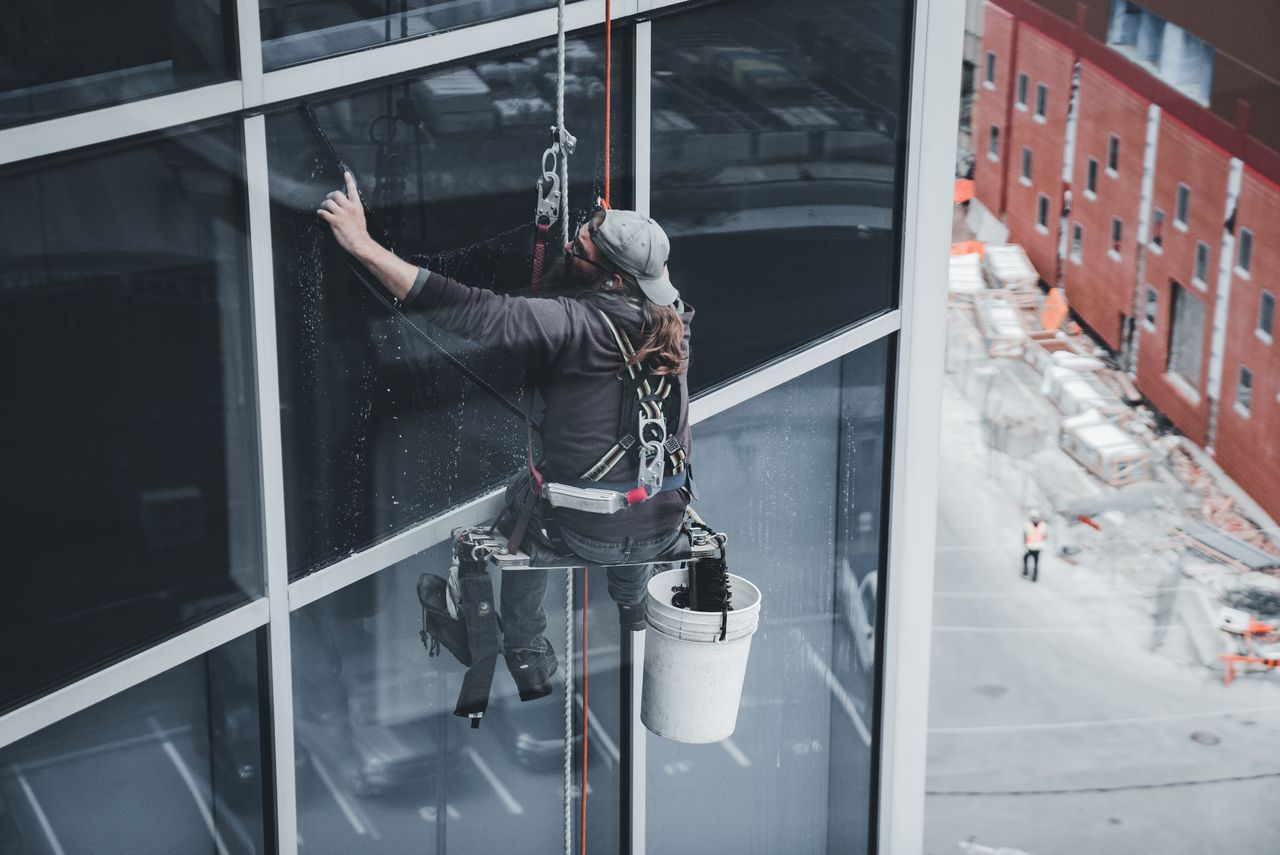
Fall protection on scaffolds is required when an employee is more than 10 feet above a lower level, under 29 CFR 1926.451(g). This is a genuine exception to the 6 foot construction rule, and it is written that way because of how scaffold platforms are built and accessed. A worker standing on a scaffold platform at 8 feet is not automatically out of compliance the way a worker on an open floor edge at 8 feet would be.
Two scaffold types demand more than the general rule:
- Single-point and two-point adjustable suspension scaffolds: the employee must be protected by both a personal fall arrest system and a guardrail system. Not one or the other. Both.
- Self-contained adjustable scaffolds: a guardrail system with a minimum 200 pound top rail capacity when the platform is supported by the frame structure, and both a personal fall arrest system and that guardrail system when the platform is supported by ropes.
Erection and dismantling is handled separately under (g)(2). The employer must have a competent person determine whether providing fall protection to the crew erecting or dismantling a supported scaffold is feasible and safe. Where it is feasible and does not create a greater hazard, it has to be provided. “Feasible” is a determination made by a named competent person on that site, not a blanket assumption made in the office.
Steel Erection: 15 Feet, and What Changes for Connectors
When is fall protection required in steel erection? Above 15 feet for most activities, and lower for connectors.
Steel erection carries the highest general trigger height in the construction standards. Under 29 CFR 1926.760, each employee engaged in a steel erection activity on a walking or working surface with an unprotected side or edge more than 15 feet above a lower level must be protected from fall hazards.
Connectors and controlled decking zones run on different numbers again:
- Connectors must be protected from fall hazards of more than two stories or 30 feet above a lower level, whichever is less.
- Connectors working over 15 and up to 30 feet above a lower level must be provided with a personal fall arrest system, a positioning device system or fall restraint system, and be wearing the equipment necessary to be tied off.
- Controlled decking zones may only be established in the area of the structure over 15 and up to 30 feet above a lower level, and employees working at the leading edge inside one must be protected from falls of more than two stories or 30 feet, whichever is less.
Ironwork is also where the multi-employer jobsite question gets sharp. A general contractor that hires a steel erector does not hand off its own duty to see that the site is safe. When we sit in on a preconstruction meeting for a transit or bridge project, the trigger height each trade is working to is a question worth asking out loud before the first piece is set.
Ladders and Stairways: Where the Rule Changes Shape
When is fall protection required on a ladder? Almost never in the form of a harness on a portable ladder, and at specific climb lengths on a fixed ladder.
Ladders are the most common source of the question and the least straightforward answer. OSHA does not require a personal fall arrest system for an employee working from a portable ladder in construction. 29 CFR 1926.1053 handles that exposure through the design and setup of the ladder itself, not through a harness.
What the standard does require:
- A stairway or ladder at every point of personnel access where there is a break in elevation of 19 inches or more, unless a ramp, runway, sloped embankment or personnel hoist is provided (29 CFR 1926.1051(a))
- Portable ladder side rails extended at least 3 feet above the upper landing surface, or the ladder secured at its top to a rigid support that will not deflect, with a grasping device provided
- Fixed ladders with cages, wells, ladder safety devices or self-retracting lifelines where the climb is less than 24 feet but the top of the ladder is more than 24 feet above lower levels
- Fixed ladders with a total climb of 24 feet or more equipped with ladder safety devices, or self-retracting lifelines with rest platforms at intervals not exceeding 150 feet, or a cage or well with multiple ladder sections
Ladders in construction sat at number three on OSHA’s fiscal year 2025 top 10 cited standards list. The findings are rarely about missing harnesses. They are about ladders that are not extended above the landing, not secured, or used as a work platform when a scaffold or lift belonged there instead.
Roofs: Low Slope, Steep Slope, and Residential
When is fall protection required on a roof? At 6 feet, with the roof type deciding which systems are acceptable once you are there. Roof work has the most options and the most confusion in the entire standard.
Low-slope roofs (b)(10)
On a low-slope roof with an unprotected side or edge 6 feet or more above lower levels, 1926.501(b)(10) permits a guardrail system, a safety net system, a personal fall arrest system, or a combination: a warning line system paired with a guardrail system, a safety net system, a personal fall arrest system, or a safety monitoring system.
There is one narrow exception. On roofs 50 feet or less in width, the use of a safety monitoring system alone is permitted, without the warning line. That exception is real, and it is also the one most often stretched past the 50 foot measurement.
Steep roofs (b)(11)
Steep roofs get a shorter menu. Employees on a steep roof with unprotected sides and edges 6 feet or more above lower levels must be protected by guardrail systems with toeboards, safety net systems, or personal fall arrest systems. Warning lines and safety monitors are not an option here.
Residential construction (b)(13)
Residential construction work at 6 feet or more requires a guardrail system, safety net system, or personal fall arrest system, unless another provision of paragraph (b) supplies an alternative. Where the employer can demonstrate that those systems are infeasible or create a greater hazard, it must develop and implement a written fall protection plan meeting 29 CFR 1926.502(k). That plan is not a form download. It has to be prepared by a qualified person, written specifically for that site, and kept current as the work changes.
Below the Trigger Height: When Is Fall Protection Required Anyway
Fall protection is required below the trigger height whenever an employee is working above dangerous equipment. Under 1926.501(b)(8), employees working less than 6 feet above dangerous equipment must be protected by guardrail systems or by equipment guards. At 6 feet or more above dangerous equipment, the full set applies: guardrail systems, personal fall arrest systems, or safety net systems.
Open drive belts, pulleys, augers, mixers, vats, presses, conveyor pinch points and exposed rebar all put the hazard below the worker rather than the height. A 4 foot fall onto a moving belt is not a lesser event than a 20 foot fall onto dirt, and the standard does not treat it as one.
Two more situations put the answer below the obvious number. Holes have to be covered or guarded regardless of depth so nobody steps into them or drops material through. And general industry work in the same building as a construction project still runs on the 4 foot rule, which means the same mezzanine can carry two different trigger heights depending on who is standing on it and what they are doing.
Which Fall Protection System Actually Meets the Standard
Knowing when is fall protection required only answers half the question. 29 CFR 1926.502 sets the criteria a system has to meet before it counts, and this is where equipment that was bought in good faith fails an inspection.
Guardrail systems
- Top rail at 42 inches plus or minus 3 inches above the walking or working level
- Top rail capable of withstanding, without failure, a force of at least 200 pounds applied within 2 inches of the top edge in any outward or downward direction
Personal fall arrest systems
- Anchorages capable of supporting at least 5,000 pounds per employee attached, or designed, installed and used under the supervision of a qualified person as part of a complete system with a safety factor of at least two
- Maximum arresting force limited to 1,800 pounds when used with a body harness
- No free fall of more than 6 feet, and no contact with any lower level
- Deceleration distance limited to 3.5 feet
That last pair is the math nobody runs on the tailboard. A 6 foot lanyard plus 3.5 feet of deceleration distance plus harness stretch plus the distance from the D-ring to the worker’s feet adds up fast. Tie off at foot level on a second-story deck and the system can be fully compliant on paper while leaving no room to stop the fall before the worker reaches the ground. Anchor point height matters as much as anchor point strength.
Safety monitoring systems and fall protection plans
A safety monitoring system requires a competent person who can recognize fall hazards, warns employees when they are working unsafely, stays close enough and visible enough to communicate, and has no other responsibilities that would take attention from monitoring. A monitor who is also running material or operating equipment is not a monitor.
Fall protection plans under 1926.502(k) are available only for leading edge work, precast concrete erection work, or residential construction where the employer can demonstrate that conventional systems are infeasible or create a greater hazard. The plan must be prepared by a qualified person, developed specifically for the site, and kept current. Three narrow categories, not a general escape hatch.
Training: The Requirement Most Crews Fail
Training is where the answer to when is fall protection required stops being about heights at all. Equipment on the wall does not satisfy 29 CFR 1926.503. The employer must provide a training program for each employee who might be exposed to fall hazards, and a competent person qualified in fall protection has to deliver it.
The program has to cover the nature of the fall hazards in the work area, the correct procedures for erecting, maintaining, disassembling and inspecting the fall protection systems in use, the use and operation of guardrail systems, personal fall arrest systems and safety monitoring systems, the role of each employee in the safety monitoring system, the limitations on the use of mechanical equipment during roofing work, the procedures for handling and storing equipment and materials and erecting overhead protection, the employee’s role in any fall protection plan, and the standards themselves.
Retraining is triggered by events, not by a calendar. It is required when changes in the workplace render previous training obsolete, when changes in the types of fall protection systems or equipment render previous training obsolete, or when an employee’s knowledge or use of the equipment shows the training did not stick.
Then there is the record. The written certification has to contain the name or other identity of the employee trained, the dates of the training, and the signature of the person who conducted the training or the signature of the employer, with the latest certification maintained. Fall protection training was the seventh most cited standard in OSHA’s fiscal year 2025 top 10. In the field, the citation is usually not that nobody was trained. It is that nobody can produce the certification when the compliance officer asks.
3 Mistakes That Turn a Compliant Site Into a Citation
Every mistake below shows up on sites where the crew can already tell you when is fall protection required. Knowing the trigger height is not what separates a clean inspection from a citation.
1. Anchoring to whatever is closest
The 5,000 pound requirement is per employee attached. Conduit, sprinkler pipe, roof vents, ductwork, guardrail posts and rebar cages are not anchorages, and hooking two workers to a single point rated for one halves the margin. Anchor points belong on a drawing before the crew arrives, chosen by a qualified person, not found on the roof at 7 a.m.
2. Treating the trigger height as the whole question
Crews measure up to the working surface and stop there. The distance that decides whether somebody hits the ground is the clearance below, and that calculation includes free fall, deceleration distance, harness stretch and the worker’s own height below the D-ring. On second-floor decks, mezzanines and short leading edges, a compliant harness with an overhead anchor is often the only arrangement that works.
3. Buying gear and skipping the written program
Harnesses, lanyards and anchors are the visible half. The written fall protection program, the competent person designation, the equipment inspection records and the signed training certifications are the half an inspector asks for first, and the half most companies cannot produce in the ten minutes they have to produce it.
Frequently Asked Questions
At what height is fall protection required in construction?
6 feet or more above a lower level, under 29 CFR 1926.501. That single figure repeats through nearly every paragraph of the standard, from unprotected edges and leading edges to hoist areas, formwork, ramps, wall openings and the catch-all for any surface the standard does not name. Crews that can recite the number and still get cited are usually missing the system criteria or the paperwork behind it, which is what our safety training programs are built to close.
Is fall protection required at 4 feet or 6 feet?
Both, depending on which standard governs the work. General industry runs on 4 feet under 29 CFR 1910.28, construction runs on 6 feet under 29 CFR 1926.501, and an industrial facility doing its own maintenance while a contractor builds an addition is running both numbers at the same time on the same property. A walkthrough that maps every elevated surface to the standard that governs it is the fastest way to settle it, which is the first thing we do on a site safety audit.
Is fall protection required when working on a ladder?
Not in the form of a harness for a portable ladder in construction. 29 CFR 1926.1053 controls that exposure through ladder setup instead: side rails extended at least 3 feet above the landing or the ladder secured at the top with a grasping device provided. Fixed ladders are different, requiring cages, wells, ladder safety devices or self-retracting lifelines once the climb reaches the 24 foot thresholds. Getting the distinction written into your policies is part of safety program implementation.
Who is responsible for providing fall protection on a jobsite?
The employer, in every case. The duty to provide fall protection, train the exposed employees and document that training sits with the employer of the workers who are exposed, and on a multi-employer site a general contractor’s own duties do not transfer to a subcontractor by contract. Companies without a full-time safety manager typically cover it with contract safety services so someone qualified owns the program.
How often is fall protection retraining required?
Whenever the conditions change, not on a fixed calendar. 29 CFR 1926.503 requires retraining when changes in the workplace or in the fall protection systems and equipment make previous training obsolete, and when an employee’s knowledge or use of the equipment shows the original training was not retained. A near miss, a new system on site or a new crew all reset the clock, which is why we build the retraining triggers into the training schedule itself rather than leaving them to memory.
Get a Straight Answer for Your Site
Sheffield Safety & Loss Control has been answering when is fall protection required on active jobsites since 2003, from our offices in Plainfield and Chicago, Illinois and Houston, Texas, across more than a dozen states. Our CSP, CHST and ASP credentialed consultants have written and audited fall protection programs on bridge, transit, university and industrial projects where the trigger height changed three times between trades. If you want your exposures mapped, your anchor points reviewed and your training records brought current, contact Sheffield Safety and we will schedule a walkthrough.
Keep reading in our jobsite safety and safety training categories.